-
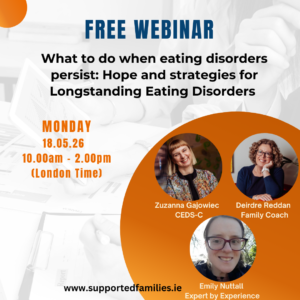
What to do when Eating Disorders Persist: Hope and Strategies for Longstanding Eating Disorders
0.00€Free webinar with Emily Nuttall, Zuzanna Gajowiec and Deirdre Reddan.
For many individuals living with longstanding eating disorders, the journey to recovery can feel exhausting, discouraging, and at times hopeless.
This free webinar explores how we can move beyond one-size-fits-all models toward multidimensional, individualized care that addresses the physical, psychological, and social realities of longstanding eating disorders.
-
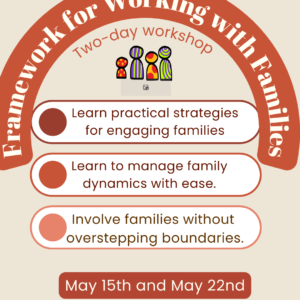
Framework for Working With Families: How to Effectively Work with Families, without breaching trust
180.00€Learn how to effectively work with families, without breaching trust. Let us teach you our proven framework!
Many healthcare and mental health professionals find working with families one of the most challenging parts of supporting eating disorder recovery.
They frequently struggle with how to involve them, how to leverage off the families strengths (and love for their person) to support recovery, while protecting client confidentiality. Families are often very overwhelmed, (understandably), making the task even more challenging.
Join us for practical, evidence based, hands on online workshop, run over two half days:
- Friday 15th May (10am-2pm) &
- Friday 22nd May (10am-2pm)
to learn how to collaborate effectively with families, no matter the age of their loved one.
-
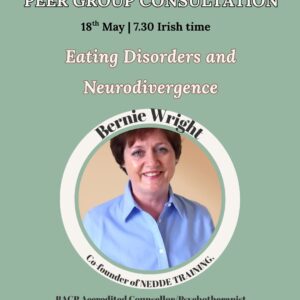
Peer Consultation and Special Interest Group for Eating Disorder Professionals.
0.00€Monday 18th May at 7.30pm Irish time
This month we’ll be joined by Bernie Wright, co-founder of NEDDE Training (Neurodiversity, Eating Disorders & Disordered Eating | NEDDE TRAINING).
Bernie will give a talk on ‘How having PDA (a pervasive drive for autonomy) can hinder eating disorder recovery’. It’s sure to be a fascinating evening so please join us!
Join our Peer Consultation and Special Interest Group for eating disorder professionals and experts by experience.
An opportunity to network, connect and learn from some amazing guest speakers.
Join us!